
Python Programming
Hands-on Python training in Port Harcourt
4 to 12 weeks
Three levels, 3-hour sessions
Beginner to backend
Start at the level that fits you
Classes from 10am
Schedule confirmed on enrolment
Certificate
Of completion at every level
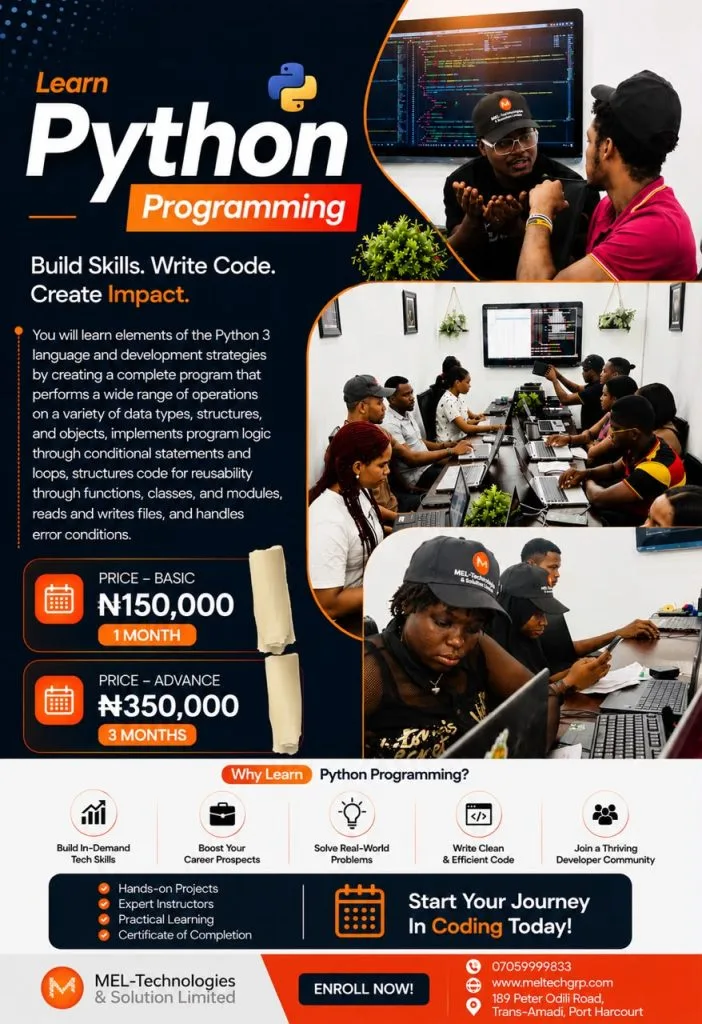
From ₦150,000
Intermediate: ₦200,000 · 8 weeks
Advanced: ₦350,000 · 12 weeks
- Live, instructor-led classes
- Hands-on labs and a capstone at every level
- Code review from certified trainers
- Certificate of completion
Choose your level.
Foundation
₦150,000
- 4 weeks · 12 sessions of 3 hours
- For complete beginners, career changers and school leavers
- Prerequisite: basic computer skills
- Capstone: a console expense tracker that saves to a file
- Leads to: Intermediate
Intermediate
₦200,000
- 8 weeks · 24 sessions of 3 hours
- For Foundation graduates, self-taught learners and CS students
- Prerequisite: Foundation or a placement test
- Capstone: an API-powered command-line app with tests
- Leads to: Advanced
Advanced
₦350,000
- 12 weeks · 36 sessions of 3 hours
- For Intermediate graduates and junior developers aiming for backend roles
- Prerequisite: Intermediate or a placement test
- Capstone: a deployed Django REST API
- Leads to: junior backend roles, freelance work, FastAPI
Go from your first line of code to a deployed application.
Foundation: Beginner
- Set up Python and VS Code and run scripts from the terminal
- Variables, numbers, strings and f-string output
- Decisions and loops with if, while and for
- Functions, lists, tuples, dictionaries and sets
- Read and write text, CSV and JSON files
- Handle errors with try/except and read a traceback
- Push your first project to GitHub
Intermediate: Python Developer
- Idiomatic Python: comprehensions, generators and itertools
- Modules, packages, virtual environments and clean project structure
- Git and GitHub: branches, pull requests and code review
- Object-oriented programming: classes, inheritance, composition and dataclasses
- Custom exceptions and logging
- Automated tests with pytest and coverage
- Call REST APIs with requests and store data in SQLite with SQL
- PEP 8, type hints and linting with ruff
Advanced: Backend Engineering with Django
- Decorators, context managers, typing and asyncio
- PostgreSQL: schema design, joins, indexes and transactions
- Django: models, views, templates, forms and the admin
- REST APIs with Django REST Framework
- Authentication, permissions and core API security (OWASP Top 10 basics)
- Payment gateway integration (Paystack sandbox) with webhooks
- Background jobs and caching with Celery and Redis
- Testing, Docker, GitHub Actions CI and live deployment
Week by week.
Foundation: Beginner
Week 1: Getting started and core building blocks
- Install Python and VS Code, terminal basics, your first program and reading error messages
- Variables, numbers, strings, booleans and type conversion
- User input, f-strings and string methods
- Labs: naira to dollar converter and a transfer-fee calculator
Week 2: Decisions and loops
- Comparison and logical operators; if, elif and else
- while and for loops, range, break and continue
- Nested loops, input validation and simple menus
- Labs: grade classifier, FizzBuzz and an ATM simulator with a 3-attempt PIN limit
Week 3: Functions and data structures
- Functions, parameters, return values and scope
- Lists, tuples, dictionaries and sets, including lists of dictionaries
- Labs: shopping-cart total with a discount code and a student result sheet
Week 4: Files, errors, modules and capstone
- Read and write text files; try, except, else and finally
- Modules, the standard library, JSON and CSV, pip and virtual environments
- Git basics and pushing a project to GitHub
- Capstone build, demo and trainer code review: the console expense tracker
Intermediate: Python Developer
Week 1: Pythonic code
- Comprehensions, enumerate, zip and unpacking
- *args, **kwargs, lambda, map and filter
- Generators and iterators; processing a 100,000-line file one row at a time
Week 2: Tools of the trade
- Git and GitHub: branches, merges and pull requests
- Project structure, packages, venv and requirements.txt
- PEP 8, docstrings, type hints and ruff
Week 3: Object-oriented programming I
- Classes, objects, __init__, methods, __str__ and __repr__
- Encapsulation, properties, class and static methods
- Modelling a small domain: students, courses and results
Week 4: Object-oriented programming II
- Inheritance, super() and polymorphism
- Composition, dataclasses and abstract base classes
- Dunder methods and a mid-course practical (2 hours, unaided)
Week 5: Reliability and files
- Custom exceptions and when not to catch
- Logging and context managers
- pathlib, csv, json and datetime with Lagos time zones
Week 6: Testing and debugging
- pytest, pytest.raises, fixtures and parametrize
- Mocking and coverage reports
- Debugging with breakpoints and a systematic method
Week 7: Libraries, APIs and databases
- HTTP, status codes, requests and API keys kept out of code
- SQL and SQLite: CRUD, JOIN and parameterised queries
- Command-line tools with argparse and packaging
Week 8: Capstone
- Proposal sign-off, architecture sketch and build
- Trainer code review, tests and README
- Demos, code review and final evaluation
Advanced: Backend Engineering with Django
Phase A, Weeks 1 to 2: Advanced Python
- Closures, decorators, context managers, functools and typing
- Common design patterns in real code
- Concurrency: threads, processes and asyncio; profiling and performance
Phase B, Weeks 3 to 4: Databases
- PostgreSQL, relational design and normalisation
- Joins, aggregates, subqueries and CTEs
- Indexes, EXPLAIN, transactions and race conditions
- Mid-course practical: design a schema and write queries from a brief
Phase C, Weeks 5 to 8: Django
- Models, the ORM, views, templates, forms and the admin
- Authentication, permissions and ownership checks
- Django REST Framework: serializers, viewsets, filtering, JWT and OpenAPI docs
Phase D, Weeks 9 to 11: Production skills
- API design and security: OWASP Top 10 for APIs, secrets and CORS
- Paystack sandbox payments with verified webhooks
- Celery, Redis and caching
- pytest-django, Docker, GitHub Actions and deployment to a live server
Phase E, Week 12: Capstone
- Architecture check, security review, README and API docs
- Demo day, live code review and final evaluation
- Career session: GitHub profile, CV and mock technical interview
Finish every level with something you built.
Console Expense Tracker
Level 1 capstone: a menu-driven program that adds expenses, totals them per category, saves to a JSON file between runs and copes with bad input.
API-Powered CLI Application
Level 2 capstone: a command-line app that calls a live API, stores data in SQLite and ships with at least 15 tests, logging and a clear README.
Deployed Django REST API
Level 3 capstone: a real-world backend such as a wallet, e-commerce or booking API, with authentication, a payment or email integration, 30+ tests, CI and a public URL, defended live.
How you are assessed.
Foundation
Quizzes 20% · Assignments 30% · Capstone demo 50%. Pass mark 60% and a capstone that runs.
Intermediate
Quizzes 15% · Assignments 25% · Mid-course practical 20% · Capstone demo 40%.
Advanced
Quizzes 10% · Assignments 20% · Mid-course practical 20% · Capstone demo 50%.
Know what you need.
Where to start
Foundation: basic computer skills only.
Intermediate: Foundation, or a placement test on functions, lists, dictionaries, files and try/except.
Advanced: Intermediate, or a placement test on OOP, pytest, Git, requests and basic SQL.
Where graduates go next
Advanced graduates are ready for junior backend and Python developer roles and freelance work, and can go on to FastAPI, Data Analytics, AI Automations or Cloud Solutions and DevOps.
Benefits of learning Python.
Finishing your search query
Uber
Calculating and displaying the ETA of your cab
Netflix
Showing the movies and TV series you will like
Ready to start your Python journey?
Before you apply.
Do I need programming experience?
No. Foundation is designed for complete beginners and only needs basic computer skills: using a computer, managing files and browsing the internet. If you already code, ask admissions about a placement test so you can join Intermediate or Advanced.
Which level should I join?
Start with Foundation if you are new to programming. Join Intermediate if you can already write functions and work with lists, dictionaries, files and try/except. Join Advanced if you are comfortable with object-oriented programming, pytest, Git, requests and basic SQL. Admissions can give you a short placement test if you are unsure.
How long is each level and what does it cost?
Foundation is 4 weeks (12 sessions of 3 hours) at ₦150,000. Intermediate is 8 weeks (24 sessions) at ₦200,000. Advanced is 12 weeks (36 sessions) at ₦350,000.
What will I be able to do after each level?
After Foundation you can write, run and debug a 100-line Python program that reads and saves data. After Intermediate you can write structured, tested, version-controlled Python and build an app that uses an API and a database. After Advanced you can design, build, secure, test and deploy a database-backed REST API with Django.
Do I get a certificate?
Yes. You receive a certificate of completion when you finish a level.
What time are classes?
Classes start from 10am. The exact schedule depends on the package you choose, and our admissions team will confirm it when you apply.
How are classes delivered and assessed?
Classes are live and instructor-led, taught by certified, experienced trainers. You are assessed through quizzes, assignments, and a capstone project that you demo and explain live. Foundation, Intermediate and Advanced each end with a capstone and code review.
Will I build anything I can show employers?
Yes. Every level ends with a capstone on GitHub: an expense tracker, an API-powered command-line app, and a deployed Django REST API with tests and CI.
How do I apply and pay?
Complete the application form at the bottom of this page or message us on WhatsApp. Our payment terms and conditions are linked in the Python benefits section.
- Live, instructor-led classes from 10am
- 3-hour sessions with hands-on labs
- A capstone project at every level
- Code review from certified trainers
- Quizzes, assignments and a live demo
- Certificate of completion
Call +234 705 9999833





Start your Python journey.
More Courses
Explore More Courses
Build complete web applications with HTML, CSS, React, Next.js, databases and live deployment.
Build Android and iOS apps from scratch with React Native or Flutter.
Analyse data and uncover insights with Python, SQL, visualisation and real datasets.

Comments are closed.