
Data Analytics
Hands-on data analytics training in Port Harcourt
1 to 3 months
Three levels, 3-hour sessions
Beginner to data scientist
Start at the level that fits you
Classes from 10am
Schedule confirmed on enrolment
Certificate
Of completion at every level
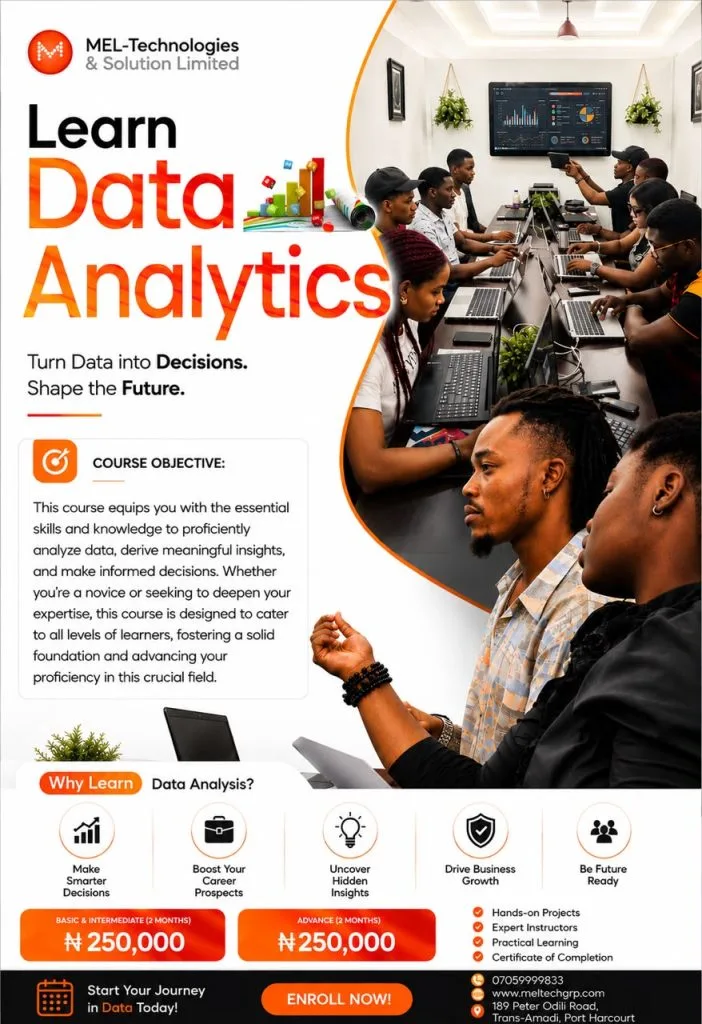
From ₦150,000
Intermediate: ₦250,000 · 2 months
Advanced: ₦300,000 · 3 months
- Live, instructor-led classes
- Real datasets and a capstone at every level
- Code review from certified trainers
- Certificate of completion
Choose your level.
Basic
₦150,000
- 4 weeks · 12 sessions of 3 hours
- For complete beginners, career changers and non-IT graduates
- Prerequisite: basic computer skills
- Capstone: a console expense tracker that saves to a file
- Leads to: Intermediate (Data Analyst)
Intermediate
₦250,000
- 2 months · 8 weeks, 24 sessions of 3 hours
- For Basic graduates, business and finance staff and non-IT graduates moving into analytics
- Prerequisite: Basic or a placement test
- Capstone: a business analysis with SQL, a dashboard and a stakeholder presentation
- Leads to: Advanced (Data Science & Engineering)
Advanced
₦300,000
- 3 months · 12 weeks, 36 sessions of 3 hours
- For Intermediate graduates, working analysts and developers
- Prerequisite: Intermediate or a placement test
- Capstone: an end-to-end data product with a pipeline, a model and a deployed API or app
- Leads to: junior data scientist, analytics engineer or data engineer roles
Go from your first line of code to a deployed model.
Basic: Python Foundation
- Set up Python and VS Code and run scripts from the terminal
- Variables, numbers, strings and f-string output
- Decisions and loops with if, while and for
- Functions, lists, tuples, dictionaries and sets
- Read and write text, CSV and JSON files
- Handle errors with try/except and read a traceback
- Push your first project to GitHub
Intermediate: Data Analyst
- Work in Jupyter and VS Code, and keep your analysis in Git
- Load data from CSV, Excel, JSON, APIs and databases into pandas
- Clean data: missing values, duplicates, wrong types, inconsistent text and outliers
- Reshape and combine data with groupby, pivot_table and merge
- Write SQL with joins, CTEs and window functions
- Choose the right chart and run an exploratory analysis
- Work with time series, descriptive statistics and hypothesis tests
- Build an interactive dashboard and present findings to a non-technical audience
Advanced: Data Science & Engineering
- Advanced pandas, data validation and feature engineering, including KNN imputation
- Leak-free machine-learning workflows with scikit-learn pipelines
- Linear models, Random Forest and XGBoost, tuned and compared with the right metrics
- Imbalanced data, forecasting and customer clustering
- Explain model predictions with feature importance and SHAP
- ETL pipelines loaded into PostgreSQL and scheduled to run
- Serve models with FastAPI or Streamlit and containerise them with Docker
- Experiment tracking with MLflow, and responsible use of data and models
Step by step.
Basic: Python Foundation
Week 1: Getting started and core building blocks
- Install Python and VS Code, terminal basics, your first program and reading error messages
- Variables, numbers, strings, booleans and type conversion
- User input, f-strings and string methods
- Labs: naira to dollar converter and a transfer-fee calculator
Week 2: Decisions and loops
- Comparison and logical operators; if, elif and else
- while and for loops, range, break and continue
- Nested loops, input validation and simple menus
- Labs: grade classifier, FizzBuzz and an ATM simulator with a 3-attempt PIN limit
Week 3: Functions and data structures
- Functions, parameters, return values and scope
- Lists, tuples, dictionaries and sets, including lists of dictionaries
- Labs: shopping-cart total with a discount code and a student result sheet
Week 4: Files, errors, modules and capstone
- Read and write text files; try, except, else and finally
- Modules, the standard library, JSON and CSV, pip and virtual environments
- Git basics and pushing a project to GitHub
- Capstone build, demo and trainer code review: the console expense tracker
Intermediate: Data Analyst
Week 1: Python for data work
- The analysis cycle: question, data, clean, explore, conclude, communicate
- Jupyter and VS Code, comprehensions, reading CSV and JSON
- Git, GitHub and a standard analysis project layout
Week 2: NumPy and pandas fundamentals
- NumPy arrays and vectorisation
- pandas Series and DataFrames, loc and iloc, filtering and sorting
- New columns, aggregates, Excel import and export
Week 3: Data cleaning
- Missing data and duplicates
- Types, text and dates, including messy ₦ amounts and phone numbers
- Outliers and simple data-quality checks
Week 4: Transform and combine
- groupby, agg, pivot_table and crosstab
- merge and concat, and checking row counts after every join
- Method chaining and a mid-course practical (2 hours, unaided)
Week 5: Visualisation and exploratory analysis
- matplotlib and seaborn; choosing a chart that fits the question
- A repeatable EDA checklist
- Interactive charts with Plotly and storytelling with data
Week 6: SQL for analysts
- SELECT, WHERE, GROUP BY and HAVING in SQLite and PostgreSQL
- Joins, subqueries and CTEs
- Window functions: ranking, running totals and month-over-month change
Week 7: Time series and statistics
- Resampling, rolling averages and seasonality
- Descriptive statistics and confidence intervals
- Hypothesis testing and A/B tests explained honestly
Week 8: Dashboards, communication and capstone
- Dashboard design in Power BI (Windows) or Streamlit (any OS)
- Data privacy and the Nigeria Data Protection Act
- Stakeholder presentations and final evaluation
Advanced: Data Science & Engineering
Phase A, Weeks 1 to 2: Advanced wrangling and feature engineering
- Advanced pandas, Parquet, databases and larger-than-memory files
- Data validation and reusable cleaning functions
- Missing-data strategies, encoding, scaling, date and lag features, and spotting data leakage
Phase B, Weeks 3 to 4: Machine-learning foundations
- The scikit-learn workflow, Pipeline and ColumnTransformer
- Regression and classification with the right metrics and a baseline to beat
- Cross-validation, overfitting and a 3-hour mid-course practical
Phase C, Weeks 5 to 7: Modelling in depth
- Random Forest and gradient boosting with XGBoost, tuning and comparison
- Imbalanced data (fraud and default), clustering and model interpretation with SHAP
- Forecasting with baselines, exponential smoothing and time-based validation
Phase D, Weeks 8 to 10: Data engineering and deployment
- ETL design, loading PostgreSQL and scheduling pipelines
- A PySpark awareness session, reproducible projects and MLflow experiment tracking
- Serving a model with FastAPI and Streamlit, Docker, CI and monitoring
Phase E, Weeks 11 to 12: Responsible data science, capstone and career
- Ethics, bias and data protection
- Capstone build, testing, documentation and a model card
- Portfolio, GitHub profile, CV, mock interviews and demo day
Finish every level with something you built.
Console Expense Tracker
Level 1 capstone: a menu-driven program that adds expenses, totals them per category, saves to a JSON file between runs and copes with bad input.
Business Analysis and Dashboard
Level 2 capstone: answer a real business question with a cleaned dataset, at least 5 SQL queries, a hypothesis test, a dashboard with working filters and a one-page recommendation.
End-to-End Data Product
Level 3 capstone: an automated pipeline into PostgreSQL, three models compared against a baseline, plain-language explanations, and a model served through FastAPI or Streamlit in Docker, defended live.
How you are assessed.
Basic
Quizzes 20% · Assignments 30% · Capstone demo 50%. Pass mark 60% and a capstone that runs.
Intermediate
Quizzes 15% · Assignments 25% · Mid-course practical 20% · Capstone presentation 40%.
Advanced
Quizzes 10% · Assignments 20% · Mid-course practical 20% · Capstone demo 50%.
Know what you need.
Where to start
Basic: basic computer skills only.
Intermediate: Basic, or a placement test on functions, lists and dictionaries, reading CSV and JSON files and try/except.
Advanced: Intermediate, or a placement test on pandas, SQL joins and window functions, descriptive statistics and hypothesis testing.
Where graduates go next
Advanced graduates are ready for junior data scientist, analytics engineer and data engineer roles, and can go on to AI Automations, FastAPI (Backend) or Cloud Solutions.
Before you apply.
Do I need experience?
No. Basic starts from zero and only needs basic computer skills: using a computer, managing files and browsing the internet. If you already code or work with data, ask admissions about a placement test so you can join Intermediate or Advanced.
Which level should I join?
Start with Basic if you are new to programming. Join Intermediate if you can write functions, use lists and dictionaries, read CSV and JSON files and handle errors with try/except. Join Advanced if you are comfortable with pandas, SQL joins and window functions, descriptive statistics and hypothesis testing. Admissions can give you a short placement test if you are unsure.
How long is each level and what does it cost?
Basic is 4 weeks (12 sessions of 3 hours) at ₦150,000. Intermediate is 2 months (8 weeks, 24 sessions of 3 hours) at ₦250,000. Advanced is 3 months (12 weeks, 36 sessions of 3 hours) at ₦300,000.
What will I be able to do after each level?
After Basic you can write, run and debug your own Python programs that read and save data. After Intermediate you can take a messy dataset, clean it, analyse it with pandas and SQL, visualise it, test a hypothesis and present findings in a dashboard and a short report. After Advanced you can build, evaluate and deploy a predictive model and the automated data pipeline that feeds it.
Which tools will I use?
Python, VS Code and Jupyter, pandas, NumPy, seaborn and Plotly, SQLite and PostgreSQL, and Power BI Desktop (Windows) or Streamlit for dashboards. Advanced adds scikit-learn, XGBoost, FastAPI, Docker and MLflow.
What data will we work with?
Relatable Nigerian data wherever possible, such as retail sales, POS and transfer transactions, school results, fuel prices, exchange rates and telecom churn. We use public, synthetic or anonymised data, and every level includes a session on data protection and the Nigeria Data Protection Act.
Do I get a certificate?
Yes. You receive a certificate of completion when you finish a level.
What time are classes?
Classes start from 10am. The exact schedule depends on the package you choose, and our admissions team will confirm it when you apply.
How are classes delivered and assessed?
Classes are live and instructor-led, taught by certified, experienced trainers. You are assessed through quizzes, assignments and a capstone project that you present and defend live.
How do I apply and pay?
Complete the application form at the bottom of this page or message us on WhatsApp. Our payment terms and conditions are linked in the tuition card at the top of this page.
- Live, instructor-led classes from 10am
- 3-hour sessions with hands-on labs
- Real datasets and a capstone at every level
- Code review from certified trainers
- Quizzes, assignments and a live demo
- Certificate of completion
Call +234 705 9999833





Start your data journey.
More Courses
Explore More Courses
Learn Python from scratch and build real programs, from your first line of code to web apps.
Connect your everyday tools and let AI handle the repetitive busywork for you.
Identify, assess and defend against cyber threats across networks, systems and data.
